Neurodiversity, Dopamine and Motivation: Why Some Tasks Feel Easier Than Others
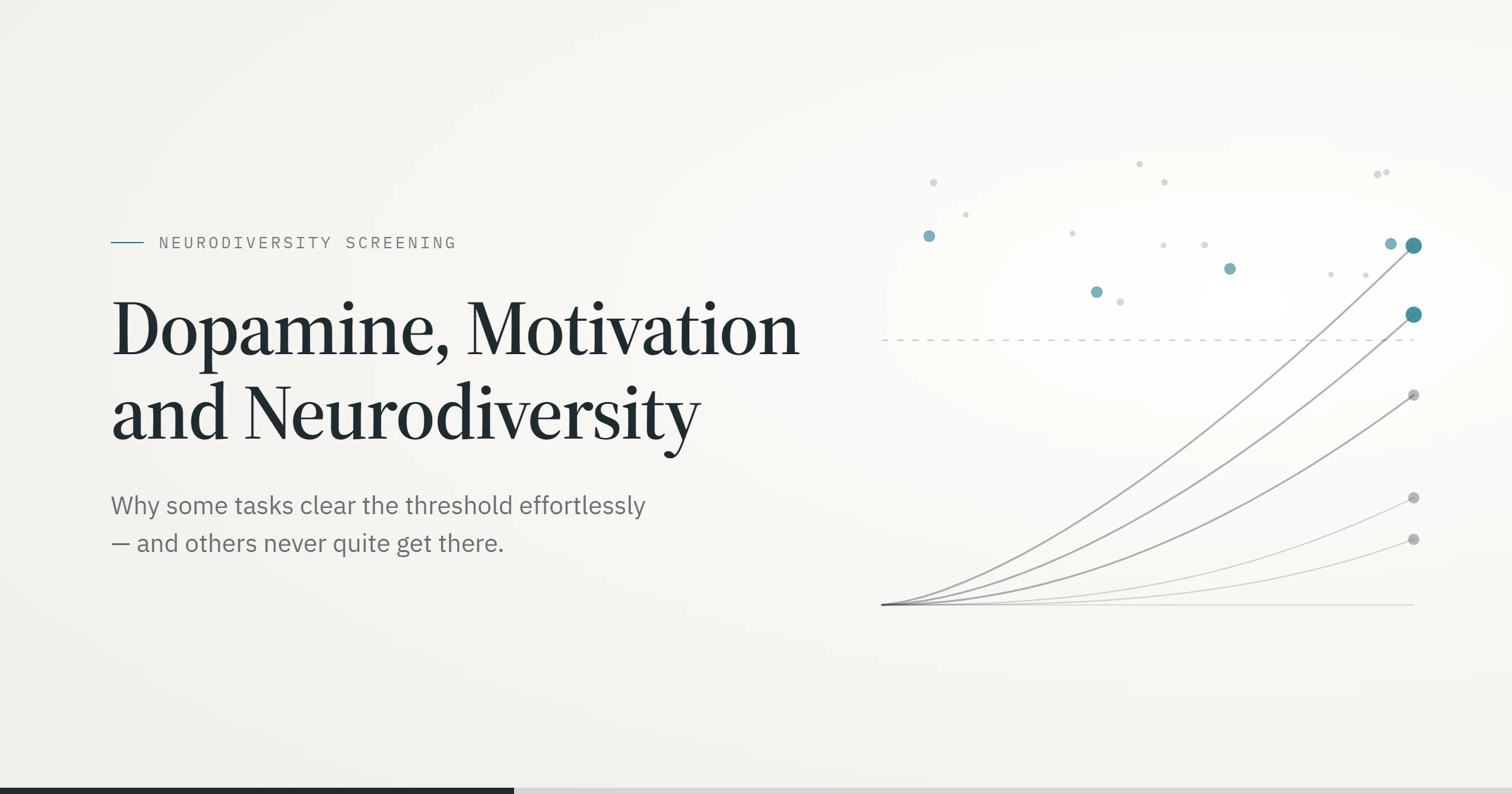
Have you ever wondered why you can spend hours focused on an interesting project, hobby or game but struggle to start a simple household task or reply to an email? Many people assume this reflects laziness or a lack of discipline. In reality, motivation is far more complex, and dopamine plays an important role in how the brain prioritises activities.
What Is Dopamine?
Dopamine is a neurotransmitter, a chemical messenger that helps different parts of the brain communicate.
Although dopamine is often described as the brain’s ‘reward chemical’, this explanation is incomplete.
Dopamine is involved in:
- Motivation
- Attention
- Learning
- Decision making
- Reward anticipation
- Goal-directed behaviour
Rather than simply creating pleasure, dopamine helps the brain decide:
“Is this worth my effort?”
This makes dopamine an important part of everyday motivation and task initiation.
Dopamine and Motivation
Many people assume motivation comes first and action comes second.
In practice, the relationship is often more complicated.
The brain constantly evaluates:
- How rewarding a task feels
- How much effort is required
- How interesting the activity appears
- Whether a reward feels immediate or distant
When a task feels rewarding or engaging, starting it often feels easier.
When a task feels repetitive, unclear or unrewarding, beginning may require significantly more effort.
Why Do Some Tasks Feel Impossible to Start?
Many people experience situations where they:
- Want to complete a task
- Understand its importance
- Intend to begin
Yet still struggle to take the first step.
This experience is often linked to task initiation difficulties and broader executive functioning challenges.
Related resources:
Real-World Example: Emma
Emma enjoys researching topics that interest her.
When she discovers a new subject, she can spend hours reading articles, watching videos and taking notes without difficulty.
However, replying to routine emails feels exhausting.
Both tasks require attention. Both tasks require effort. Yet one activity feels effortless while the other feels impossible to begin.
Dopamine and Attention
Motivation and attention are closely connected.
Activities that feel interesting, novel or rewarding often attract attention more easily.
Activities that feel boring, repetitive or lacking in immediate reward may require greater conscious effort.
Dopamine and ADHD
Discussions of dopamine frequently occur in relation to ADHD.
Researchers believe dopamine plays an important role in the attention and motivation differences often associated with ADHD.
Common experiences may include:
- Difficulty starting low-interest tasks
- Seeking novelty and stimulation
- Inconsistent motivation
- Strong engagement with preferred activities
- Task initiation challenges
Why Motivation Can Feel Inconsistent
One of the most confusing experiences for many people is inconsistency.
For example:
Monday
Complete an entire project in a few hours.
Tuesday
Struggle to answer a single email.
Motivation is influenced by many factors including interest, energy levels, cognitive load, environment, stress, sleep quality and reward perception.
Dopamine and Hyperfocus
Dopamine is also frequently discussed alongside hyperfocus.
Hyperfocus describes periods of intense concentration on an activity.
During hyperfocus, people may:
- Lose track of time
- Ignore distractions
- Forget meals or breaks
- Become deeply immersed in an activity
Related resource:
Real-World Example: James
James enjoys solving technical problems.
When presented with a complex challenge, he can focus for hours without noticing the passage of time.
However, scheduling appointments, completing paperwork and responding to administrative requests often remain unfinished.
Dopamine, Executive Function and Task Initiation
Dopamine interacts with executive functioning processes that help us:
- Plan activities
- Organise tasks
- Prioritise goals
- Start actions
- Maintain attention
This is why discussions about dopamine often overlap with:
- Executive Dysfunction Explained
- Task Initiation Difficulties Explained
- What Is Time Blindness?
- Working Memory Explained
Can Understanding Dopamine Help?
Instead of asking:
“Why am I so lazy?”
It can be helpful to ask:
“What factors make this task difficult for me to engage with?”
Frequently Asked Questions
What does dopamine do?
Dopamine helps support motivation, attention, learning, reward anticipation and goal-directed behaviour.
Is dopamine just the pleasure chemical?
No. Dopamine is involved in much more than pleasure.
Does dopamine affect motivation?
Yes. Dopamine plays an important role in how rewarding or worthwhile an activity feels.
Is dopamine linked to ADHD?
Researchers believe dopamine plays an important role in the attention and motivation differences associated with ADHD.
Related Resources
- Executive Dysfunction Explained
- Task Initiation Difficulties Explained
- Working Memory Explained
- What Is Time Blindness?
- What Is Hyperfocus?
- Why Cognitive Profiling?
- Signs You May Be Neurodivergent
External Links
Explore Your Cognitive Profile
Motivation is only one part of understanding how your brain works.
Explore patterns across attention, executive functioning, sensory processing, social energy, emotional regulation and more.
- 100% Private & Anonymous
- No account required
- No password login
- No tracking cookies
- 30-day secure access code only you hold
- We never store or sell your personal screening data
⚠️ Educational Screening Notice and Disclaimer
This screening tool uses self-reported behavioural data to map cognitive trends. It does not provide a formal medical or psychiatric diagnosis of any condition. This system is designed solely to provide personal insight, highlight functional strengths and supply an organised baseline for users looking to explore their profiles further with a qualified healthcare professional