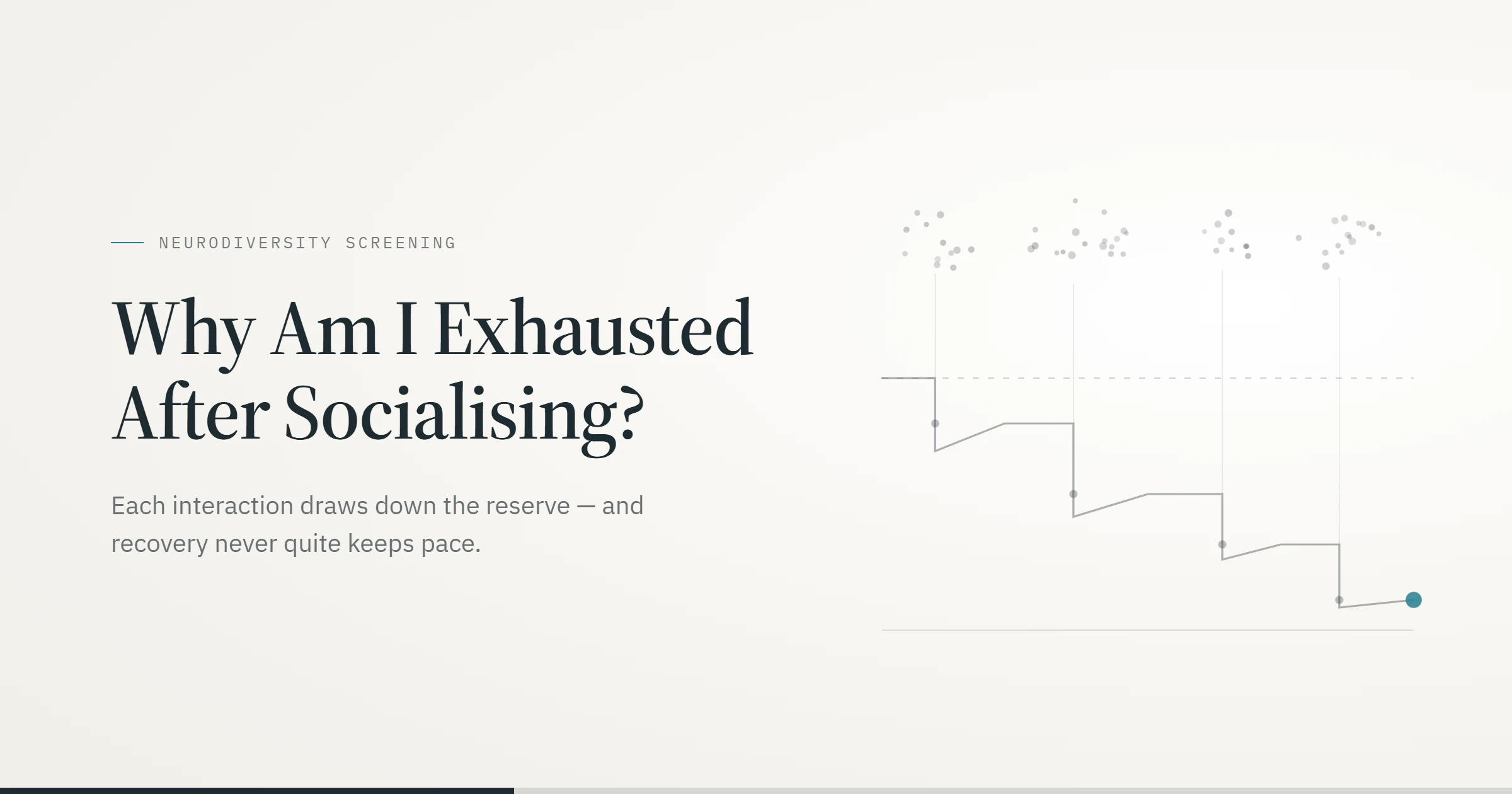
Why Am I Exhausted After Socialising? Understanding Social Energy and Social Fatigue
Do you enjoy spending time with other people but feel completely drained afterwards? Do social events leave you needing hours or even days to recover? If so, you may be experiencing differences in social energy rather than simply being shy or antisocial.
Why Do I Feel Exhausted After Socialising?
Many people assume that if they enjoy socialising, it should energise them.
In reality, social interaction requires a variety of cognitive processes, including:
- Listening and responding
- Reading social cues
- Maintaining conversations
- Managing attention
- Processing sensory information
- Monitoring behaviour
For some people, these activities occur naturally and require relatively little effort.
For others, they can consume significant mental energy.
This is why social situations can feel enjoyable while also being exhausting.
What Is Social Exhaustion?
Social exhaustion refers to the mental and physical fatigue that can occur following social interaction.
It is not necessarily caused by disliking people.
Instead, it often reflects the amount of energy required to participate in social situations.
Common signs include:
- Feeling mentally drained after conversations
- Wanting time alone after social events
- Difficulty concentrating after interacting with others
- Feeling overwhelmed after group situations
- Avoiding plans because of exhaustion
- Needing recovery time after meetings or gatherings
Related resource:
Social Exhaustion Explained
What Is Social Energy?
Social energy refers to the mental resources available for social interaction.
Just as physical energy levels differ between individuals, social energy levels vary as well.
Some people can spend hours in busy social environments and feel relatively unaffected.
Others may find that even enjoyable interactions require considerable recovery.
Understanding social energy can help explain why social experiences affect people differently.
Related resource:
What Is Social Energy?
Real-World Example: Emma
Emma enjoys meeting friends and attending social events.
While socialising, she appears engaged and comfortable.
However, after returning home, Emma feels mentally exhausted and spends the following day recovering.
For years, Emma assumed everyone experienced this level of fatigue.
Later, she realised that her social energy needs were different from those of many people around her.
Why Socialising Can Feel Draining
There is rarely a single explanation.
Several factors can contribute to social exhaustion.
Processing Social Information
Conversations require constant processing of information.
This includes:
- Listening
- Interpreting language
- Following social cues
- Responding appropriately
- Managing attention
The more cognitive effort required, the more energy may be consumed.
Sensory Processing
Many social environments contain:
- Background conversations
- Music
- Bright lighting
- Crowded spaces
- Multiple sources of information
Managing this sensory input can increase fatigue.
People who experience sensory sensitivities may find busy environments particularly tiring.
Social Expectations
Social situations often involve unspoken rules and expectations.
Examples include:
- Taking turns speaking
- Reading body language
- Managing eye contact
- Understanding social norms
Monitoring these factors can require additional mental effort.
Autism Masking and Social Exhaustion
For many autistic adults, social exhaustion may be connected to masking.
Masking involves consciously or unconsciously adapting behaviour to meet social expectations.
Examples may include:
- Rehearsing conversations
- Monitoring body language
- Suppressing discomfort
- Imitating social behaviours
While masking can help people navigate social situations, it often requires significant mental energy.
Related resource:
Socialising and Neurodiversity
Social fatigue is often discussed within neurodiversity because some neurodivergent individuals report requiring more social recovery time.
Experiences may be associated with:
- Autism
- ADHD
- AuDHD
- Sensory sensitivities
- Social communication differences
It is important to remember that experiences vary significantly between individuals.
Not everyone will have the same challenges or recovery needs.
Real-World Example: James
James attends a workplace networking event.
Throughout the evening, James actively participates in conversations and appears comfortable.
The following day, however, James feels mentally exhausted and struggles to focus on work.
The event itself was enjoyable.
The exhaustion comes from the amount of energy required to maintain social engagement over an extended period.
Social Exhaustion vs Introversion
These concepts are often confused.
Introversion
Generally refers to a personality preference for lower levels of social stimulation.
Social Exhaustion
Refers to fatigue resulting from social interaction.
While introverted people may experience social exhaustion, extroverted people can experience it too.
The key difference is that social exhaustion focuses on energy expenditure rather than personality traits.
Signs You May Need Social Recovery Time
You may benefit from social recovery if you:
- Feel mentally drained after social events
- Need quiet time following interaction
- Avoid making plans back-to-back
- Feel overwhelmed after group activities
- Struggle to focus after intensive social situations
- Prefer periods of solitude between commitments
Recognising these patterns can help people plan activities more effectively and reduce burnout.
How Understanding Social Energy Can Help
Many people spend years criticising themselves for feeling tired after social interaction.
They may wonder:
- Why am I exhausted after socialising?
- Why do others seem unaffected?
- Why do I need so much recovery time?
Understanding social energy provides a different perspective.
Rather than viewing exhaustion as a weakness, it can be understood as part of an individual’s cognitive profile.
Related resources:
- Why Cognitive Profiling?
- What Are Traits, Sub-Traits and Cognitive Spectrums?
- Signs You May Be Neurodivergent
Frequently Asked Questions
Why am I exhausted after socialising?
Social interaction requires cognitive, emotional and sensory processing. For some people, these activities consume significant mental energy and create a need for recovery.
Is social exhaustion a sign of autism?
Social exhaustion can occur for many reasons. Some autistic individuals report social fatigue, particularly when masking or managing complex social environments.
Can ADHD cause social exhaustion?
Some people with ADHD report social fatigue related to attention regulation, sensory processing and social demands.
Is it normal to need time alone after socialising?
Many people benefit from periods of recovery after social interaction. The amount of recovery needed varies between individuals.
How can I better understand my social energy?
Exploring patterns in communication, sensory processing, social interaction and recovery needs can help identify what affects your social energy levels.
Related Resources
- Autism Masking in Adults
- Social Exhaustion Explained
- What Is Social Energy?
- Why Cognitive Profiling?
- Signs You May Be Neurodivergent
- What Are Traits, Sub-Traits and Cognitive Spectrums?
- Screening Assessment vs Clinical Diagnosis
External Link
Explore Your Cognitive Profile
Social energy is just one aspect of understanding how you experience the world.
Explore patterns across social interaction, sensory processing, executive functioning, attention and emotional regulation.
- 100% Private & Anonymous
- No account required
- No password login
- No tracking cookies
- 30-day secure access code only you hold
- We never store or sell your personal screening data
⚠️ Educational Screening Notice and Disclaimer
This screening tool uses self-reported behavioural data to map cognitive trends. It does not provide a formal medical or psychiatric diagnosis of any condition. This system is designed solely to provide personal insight, highlight functional strengths and supply an organised baseline for users looking to explore their profiles further with a qualified healthcare professional