
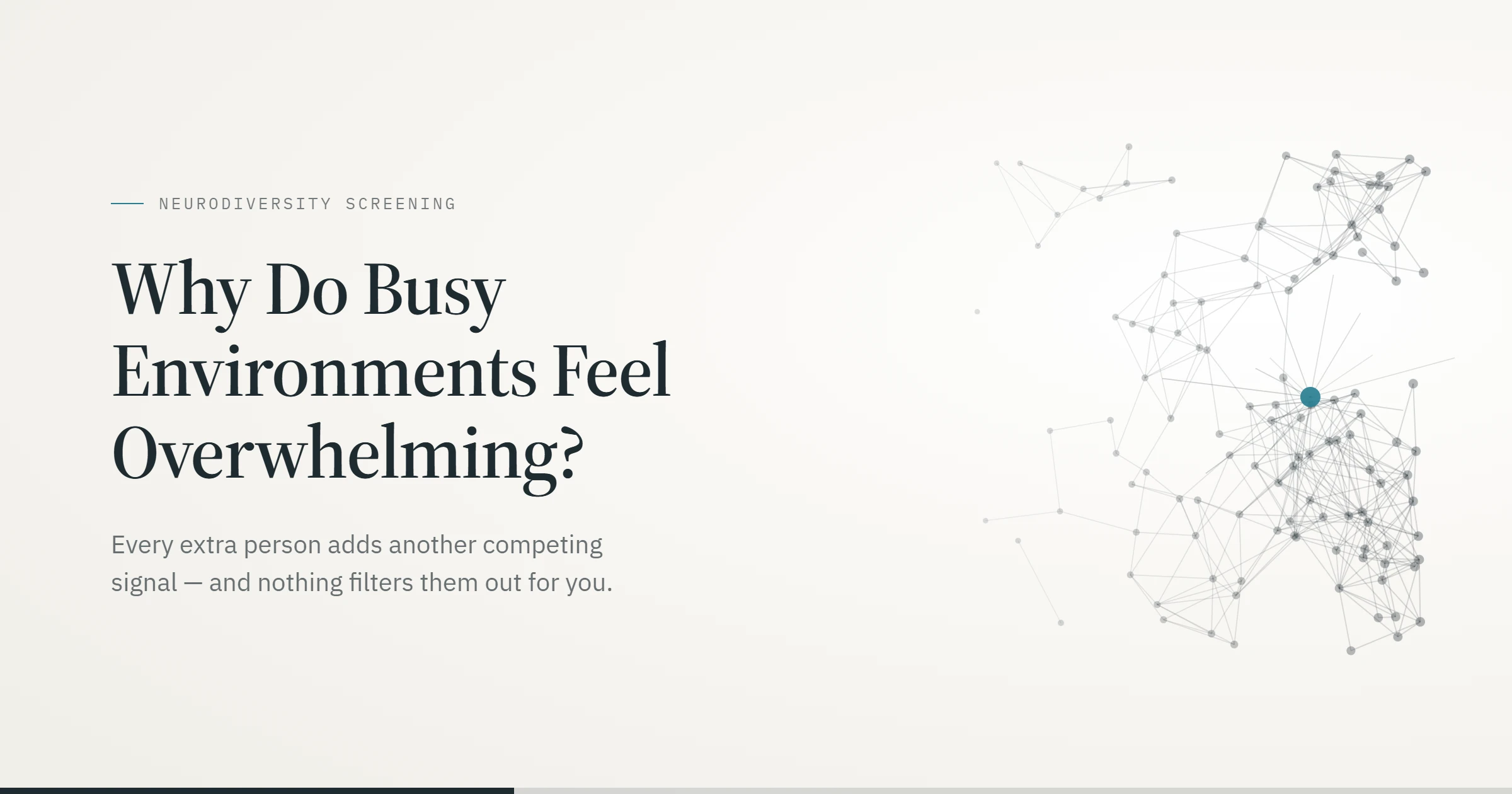
Why Do Busy Environments Feel Overwhelming?
Have you ever stepped into a train station at rush hour, or a school pickup line or a family gathering, and felt your energy drain within minutes — even though nothing “bad” was happening?
Do you find yourself needing to plan an exit route before you’ve even settled in? If so, you’ve likely experienced the particular kind of overwhelm that busy environments create.
What Makes an Environment Feel “Busy”?
A busy environment isn’t just one with a lot of noise or light — it’s one that makes constant, shifting demands on your attention.
People move unpredictably, conversations start and stop, decisions need to be made quickly and there’s rarely a moment to simply pause and process.
This is different from straightforward sensory overload.
It’s less about the volume of input and more about the unpredictability and pace of it — the brain has to keep tracking, filtering and re-filtering what matters moment to moment.
What Does It Feel Like?
Common descriptions include:
- Feeling “on alert” the whole time you’re there
- Struggling to hold a conversation while everything else is happening
- Losing track of what you were doing or saying
- A creeping sense of urgency to leave
- Feeling drained afterwards, even if the visit was short
- Needing to mentally rehearse or plan before entering the space
Real-World Example: James
James arrives at a family barbecue. There are several conversations happening at once, children running between adults, someone asking him a question while another relative waves from across the garden.
Within twenty minutes, James finds he’s stopped following any single conversation properly and starts looking for a quiet corner — or the door.
Why the Brain Struggles with Busy Environments
Attention works like a spotlight: it can only fully illuminate one or two things at a time.
In a busy environment, that spotlight is asked to jump constantly — from a passing person, to a change in noise, to a direct question, to your own next move — with very little downtime in between.
Related resource: What Are Traits, Sub-Traits and Cognitive Spectrums?
What Makes Busy Environments Overwhelming?
Unpredictability
- People moving in unexpected directions
- Conversations changing topic or direction suddenly
- Not knowing what will happen next
Competing Demands
- Needing to listen, respond and navigate at the same time
- Being asked questions while distracted
- Juggling a task (like carrying items or minding children) alongside everything else
Social Complexity
- Multiple people wanting attention at once
- Reading tone, body language and words simultaneously
- Uncertainty about social “rules” in a new or shifting setting
Time Pressure
- Feeling rushed to decide or respond
- Queues, crowds or schedules adding urgency
- No natural pause to reset
Signs You’re Finding an Environment Overwhelming
Cognitive Signs
- Losing your train of thought
- Struggling to make simple decisions
- Feeling like your thinking has “slowed down”
Physical Signs
- Tense shoulders or jaw
- Restlessness or fidgeting
- Feeling tired despite not being physically active
Emotional Signs
- Irritability or short temper
- A strong urge to leave
- Feeling flat or numb once you’re out
Busy Environments and Neurodiversity
Difficulty with busy, unpredictable environments is frequently discussed within neurodiversity, and may be associated with autism, ADHD, AuDHD and differences in attention regulation.
Related resource: Signs You May Be Neurodivergent
Busy Environments and Social Energy
Navigating a busy environment often draws on social energy as much as sensory or cognitive energy — particularly when it involves conversation, eye contact or reading other people.
Related resources:
- Why Am I Exhausted After Socialising?
- Social Exhaustion Explained
- Understanding Social Recovery Time
Practical Strategies for Navigating Busy Environments
- Scope out quieter spots or exits in advance
- Build in short breaks rather than waiting until you’re depleted
- Reduce the number of demands you take on at once (e.g. don’t carry a task and hold a conversation)
- Arrive slightly early or leave slightly late to avoid the busiest moments
- Plan recovery time afterwards rather than straight after one commitment into another
Expert Perspectives
Dr Temple Grandin
The world needs different kinds of minds.
Dr Luke Beardon
If you’ve met one autistic person, you’ve met one autistic person.
Frequently Asked Questions
Why do busy environments feel more tiring than quiet ones? Busy environments demand constant shifts in attention, which is more cognitively costly than steady, predictable input.
Is this the same as sensory overload? They’re related but not identical — sensory overload is about the volume of sensory input, while this is more about unpredictability and competing demands on attention.
Can this affect anyone, or only neurodivergent people? Anyone can find busy environments draining; some neurodivergent people report experiencing it more intensely or more often.
Related Resources
Signs You May Be Neurodivergent
What Are Traits, Sub-Traits and Cognitive Spectrums?
Why Am I Exhausted After Socialising?
Understanding Social Recovery Time
External Links
Explore Your Cognitive Profile
- 100% Private & Anonymous
- No account required
- No password login
- No tracking cookies
- 30-day secure access code only you hold
- We never store or sell your personal screening data
⚠️ Educational Screening Notice and Disclaimer
This screening tool uses self-reported behavioural data to map cognitive trends. It does not provide a formal medical or psychiatric diagnosis of any condition. This system is designed solely to provide personal insight, highlight functional strengths and supply an organised baseline for users looking to explore their profiles further with a qualified healthcare professional